
Hampton Plantation – McClellanville – Charleston County
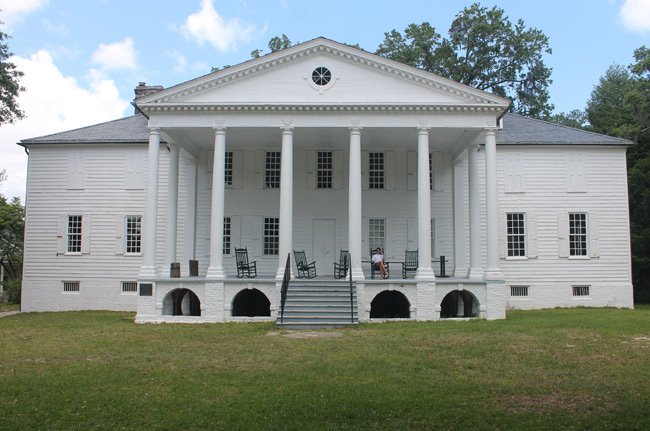
— Hampton Plantation © Carmen Pinckney, 2013 —
(Do Not Use Without Written Consent)
Basic Information
- Location – Wambaw Creek (a branch of the South Santee River), McClellanville, St. James Santee Parish, Charleston County
Located at 1950 Rutledge Road, 9 miles north of McClellanville off US 17
- Origin of name – Hampton was probably named after Hampton House, a house in Hampton-on-the-Thames, England. It was owned by David Garrick, a famous actor in the mid-1700s.
- Other names – Horry Plantation
- Current status – Open to the public as a State Historic Site
Timeline
- ? – Earliest known date of existence
The Sewee Indians occupied this area in the 1600s but had declined in numbers by 1701. The Sewee's chief, known as King Jeremy, seems to have had land near the Santee River (5, p. 705).
- Circa 1701 – Daniel McGregor was issued a warrant for 500 acres noted as being "formerly ye plantation of King Jeremy" (5, p. 705).
- Circa 1702 – Daniel McGregor sold the tract to Jacob LaPorte and Elias Horry (5, p. 705).
- 1708 – Jacob LaPorte bought out partner Elias Horry and combined the plantation with another 200-acre tract he had purchased, increasing the size to 700 acres (5, p. 705).
- 1709 – John Fillebien bought the 700-acre plantation from Jacob LaPorte (5, p. 705).
- 1710 – John and Katherine Fillebien sold the plantation to Joseph Spencer, Sr. and Mark Slowman. Slowman and Spencer split the property into two 350-acre pieces with each becoming sole owner of one piece. Spencer increased his plantation to 600 acres by acquiring an additional 250 acres to the west (5, p. 705).
- 1736 – John Spencer, Sr. died and his son John Spencer, Jr. received the 600-acre plantation (5, p. 705).
- 1737 – John Spencer, Jr. and Dorothy Spencer sold the property to Anthony Bonneau (5, p. 705).
- 1744 – Daniel Horry purchased the 600 acres from his brother-in-law Anthony Bonneau (5, p. 705).
- Mid-1740s – House built (12)
It is believed Horry constructed a house shortly after he purchased the property from Bonneau (5, p. 706).
- 1762 – Daniel Huger Horry inherited the 600-acre plantation and slaves from his father, Daniel Horry. When Daniel Horry wrote his will in 1758, he stated that his son could not inherit until he turned 21 or had children of his own, whichever came first. Daniel Huger Horry must have been twenty-one or older at the time of his father's death (8) (12).
Daniel Huger Horry and his wife, Judith Serre Horry, made Hampton their home. Judith died in 1765 and Daniel remarried three years later. There were no children from his first marriage (12).
- 1760s – Two wings were added to each side of the house. One wing was a ballroom and the other included a dining room and two other rooms. During the construction, false windows were added to maintain the symmetry of the structure (12).
- 1768 – Daniel Huger Horry remarried again, this time to Harriott Pinckney, daughter of Eliza Lucas and Charles Pinckney. They made their home at Hampton (12).
- 1769-1770 – Daniel and Harriott Horry had two children named Daniel and Harriott (12).
- 1778 – The plantation became a refuge during the Revolutionary War for relatives and friends of Daniel and Harriott. Eliza Lucas Pinckney, Harriott's mother, was one of the refugees (4, p. 73) (12).
- 1780 – The British captured Charleston. Stating that any man bearing arms against them would be treated as a traitor, they searched houses and plantations, confiscating any valuables, including slaves. Hampton was searched twice (4, pp. 78-79) (12).
During the first search, the British were looking for Francis Marion. Marion had stopped off at Hampton for some food. While it was being prepared he fell asleep and the British came riding up. Harriott Horry instructed Marion to swim across the creek and hide out in the rice fields. Marion escaped and the house was searched, but nothing was taken or destroyed (12).
During the second search, the British were looking for Daniel Huger Horry and Major Thomas Pinckney. Major Pinckney escaped but Horry was made to surrender and pledge his loyalty to the British. He did so in order to protect his family and property. The house was thoroughly plundered but no buildings were burned (4, p. 80-82) (12).
- 1782 – The British Parliament voted to end the war and establish peace. British troops left Charleston in December. At this time, all those who had been loyalists during the war were deemed traitors by the Americans, and their property was confiscated. Daniel Huger Horry was considered a traitor but his Pinckney in-laws helped defend him. He had to pay an Amercement Tax (a fine) to keep his property (4, p. 96-97) (12).
Once the war was over Daniel worked to restore the plantation and its rice fields (12).
- 1785 – Daniel Huger Horry died in November. His symptoms lead one to believe he died of liver failure. Harriott described his illness in the following excerpt of a letter written to her mother:
"Monday night
Nov.b 7th 1785
...We found M.r Horrÿ seriously ill... he is as yellow as the darkest Orange. The Bile is so much with the Blood.... he has had the hiccough's almost continually these two days.... , he speaks very thick and is much confused, is scarce ever free from the hiccoughs and his tongue is much crusted.....
Tuesday Morning 11 O'Clock.
M.r Horrÿ slept all night, but very uneasily, he breaths hard and complains much of a great oppression at his stomach he talks a good deal but very confusedly, his pulse appears to me to be good but I think he is too warm upon the whole as I think him worse than he was yesterday..." (6)
In his will, Daniel left ownership of Hampton to his son, Daniel. However, Harriott was given use of the plantation for the rest of her life. Once she died, Daniel would have complete control of the plantation (9).
Daniel Horry, the son, was living in Europe at the time. He later changed his name to Charles Lucas Pinckney Horry and never returned to his home. His mother and grandmother continued to manage the plantation in his absence (12).
- 1786 – An inventory was done of Daniel Huger Horry's estate. Every item he owned was recorded and appraised, from slaves to furniture to horses (12).
- 1790-1791 – Harriott and Eliza had a portico built on the land side of the house. It was the first Adam-style portico built in the Lowcountry. The portico is almost an exact copy of the one on David Garrick's house, Hampton House, in Hampton-on-the-Thames, England (12).
- 1791 – George Washington visited Hampton during his Southern Tour (12).
While visiting, the President was asked whether a certain oak tree should be cut down to create a better view from the portico. He replied that he liked the tree, and it was saved. From then on the tree was known as the Washington Oak (4, pp. 120-121).
- 1793 – Eliza Lucas Pinckney died in Philadelphia. It is believed that she had cancer and was seeking treatment there. George Washington asked to be a pallbearer because he thought so highly of Eliza and her family (12).
- 1797 – Daniel and Harriott's daughter, Harriott, married Frederick Rutledge. They made their home at Hampton (12).
- 1824 – Frederick Rutledge died leaving Harriott with eight children. She and her mother continued to manage the plantation and raise the children (12).
One of the eight children, John Henry Rutledge, met with a tragic ending. The story is that he committed suicide because he was not allowed to marry a certain woman. He shot himself in the house at the age of 21 (12).
- 1828 – Daniel Horry (Charles Lucas Pinckney Horry) died and left all of his property in South Carolina and France to his mother, Harriott Pinckney Horry, and wife, Elenore Marie Florimonde de Foy La Tour Marbourg Horry. They were to have equal shares and could not dispose of their half without the consent of the other (10).
Daniel Horry's wife eventually sold parts of her share, but Hampton remained in the ownership and management of his mother (12).
- 1830 – Harriot Picnkney Horry died and left Hampton to her daughter, Harriott Horry Rutledge (11).
Harriott Horry Rutledge continued to manage the plantation. Two of her sons helped when they could, but both were pursuing other careers. Henry Middleton Rutledge, a grandson, inherited the plantation (5, pp. 708-709).
- 1865 – Henry Middleton Rutledge returned from the Civil War and began to manage the plantation (12).
- 1866 – Henry Middleton Rutledge married Anna Marie Blake. They were married for ten years before Anna died (12).
- 1876 – Henry Middleton Rutledge married Margaret Hamilton Seabrook. From this marriage Archibald Hampton Rutledge was born. The Rutledges worked to send their youngest son to school and earn enough money to pay the taxes for Hampton Plantation (5, p. 709).
Archibald Rutledge did get his education and he went on to teach school in Pennsylvania. He wrote numerous books and poems and became the first Poet Laureate of South Carolina (12).
- 1937 – Archibald Rutledge returned to live at Hampton. He restored the house and wrote a book about it called Home by the River
(5, p. 709).
- 1971 – The South Carolina State Park Service gained ownership of Hampton Plantation after the death of Archibald Rutledge. It became a State Historic Site and after restoration was opened to the public (2, p. 2).
 (
(
Land
- Number of acres – 500 circa 1701; 700 in 1708; 350 in 1710; 600 in 1736; 294 in 1976 (2) (5)
- Primary crop – Rice
- Near the center of the plantation's property is Sam Hill Cemetery. The land-use-rights of this 20-acre African-American cemetery is still held by descendants of the slaves that were originally granted these rights (2, p. 6).
Slaves
Buildings
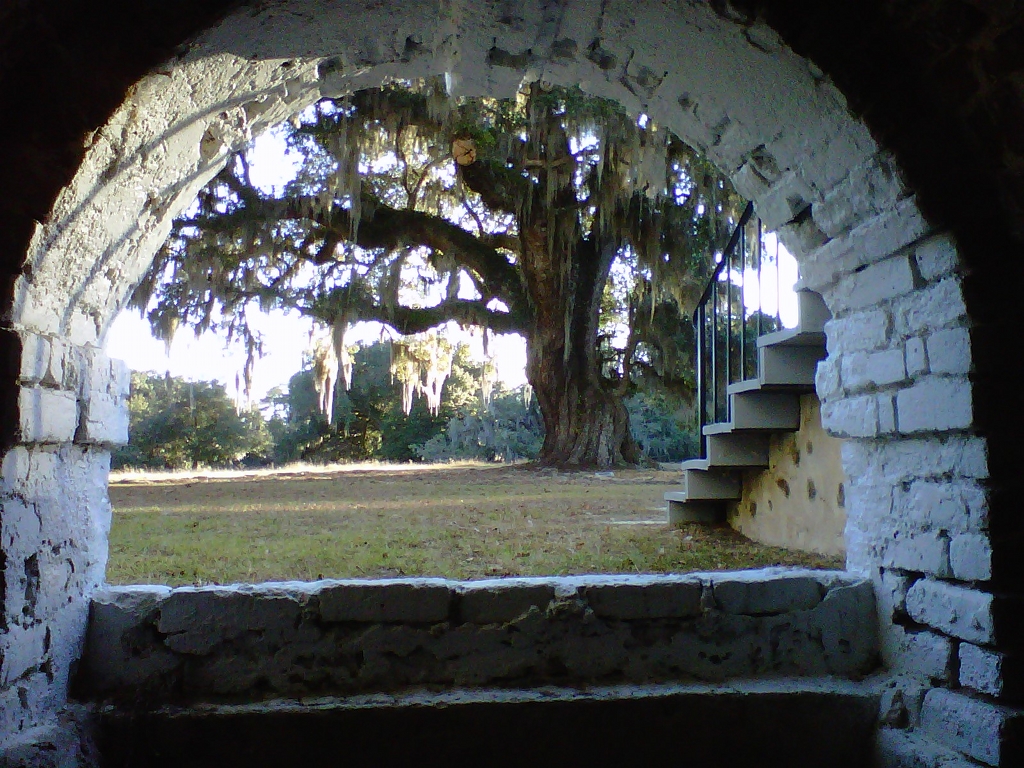
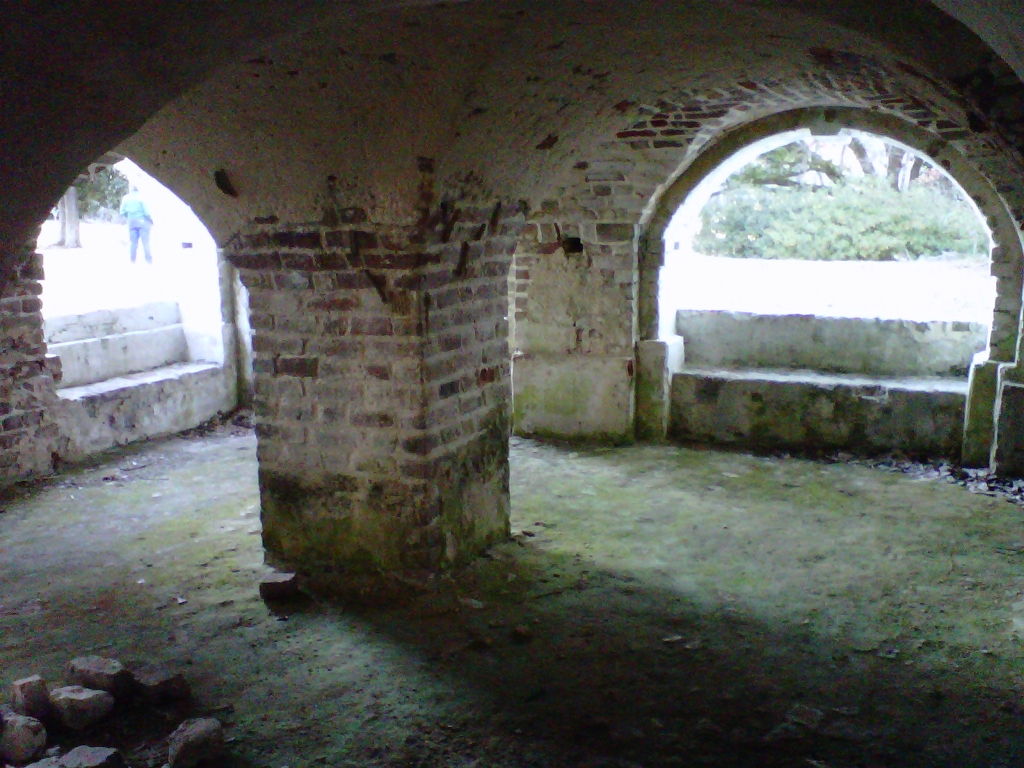
- Plantation house – Architectural historians date the original part of the house to the 1740s. Two wings were added in the 1760s and the portico was added in 1791. The house is an example of Georgian architecture with an attic and raised basement that run the length of the house. Cypress and loblolly pine trees were used to construct the house.
Daniel Horry's inventory list twelve rooms in the house with one of the rooms being a ballroom. The floorboards in the ballroom are almost 40 feet long and are made from the pine trees that were on the property.
The whole house is put together using mortise and tenon joints secured with pegs. Each piece of wood for the frame of the house was cut and marked with roman numerals and then put together like a puzzle. Evidence of this type of construction can still be seen in the house.
The portico was designed in the Adam style of architecture. It was the first of its kind to be built in the Lowcountry. It was modeled after the portico on David Garrick's house called Hampton House in Hampton-on-the-Thames, England. Archibald Rutledge removed the original bases of the columns and replaced them with concrete ones. In 2003, one of the columns was taken down, repaired, and then placed back on a new base. Using historic pictures and drawings the new base was designed to look like the original.

— Hampton Plantation Bedroom - Open Parks Network, Circa 1970 —
References & Resources
- Hampton Plantation State Historic Site: Click here
- National Register of Historic Places
– Nomination form - PDF - submitted in 1976
– Photographs, architectural overview
- Hampton Plantation - SC Picture Project: South Carolina Citizen History
- Anne Baker Leland Bridges and Roy Williams III, St. James Santee, Plantation Parish: History and Records, 1685-1925

Contact Information
- Hampton Plantation State Historic Site
1950 Rutledge Road
McClellanville, SC 29458
Telephone: 843-546-9361
Website: Click here
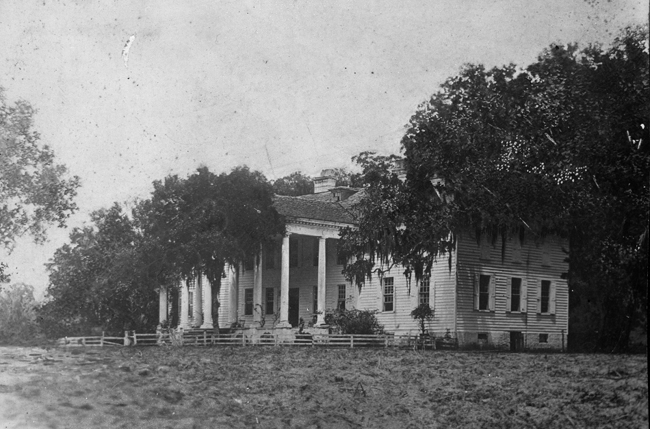
— Hampton Plantation - Open Parks Network, Circa 1905 —
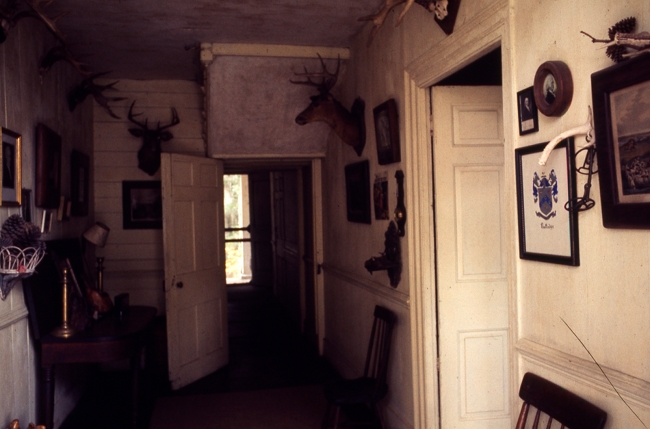
— Hall at Hampton Plantation - Open Parks Network, Circa 1970 —
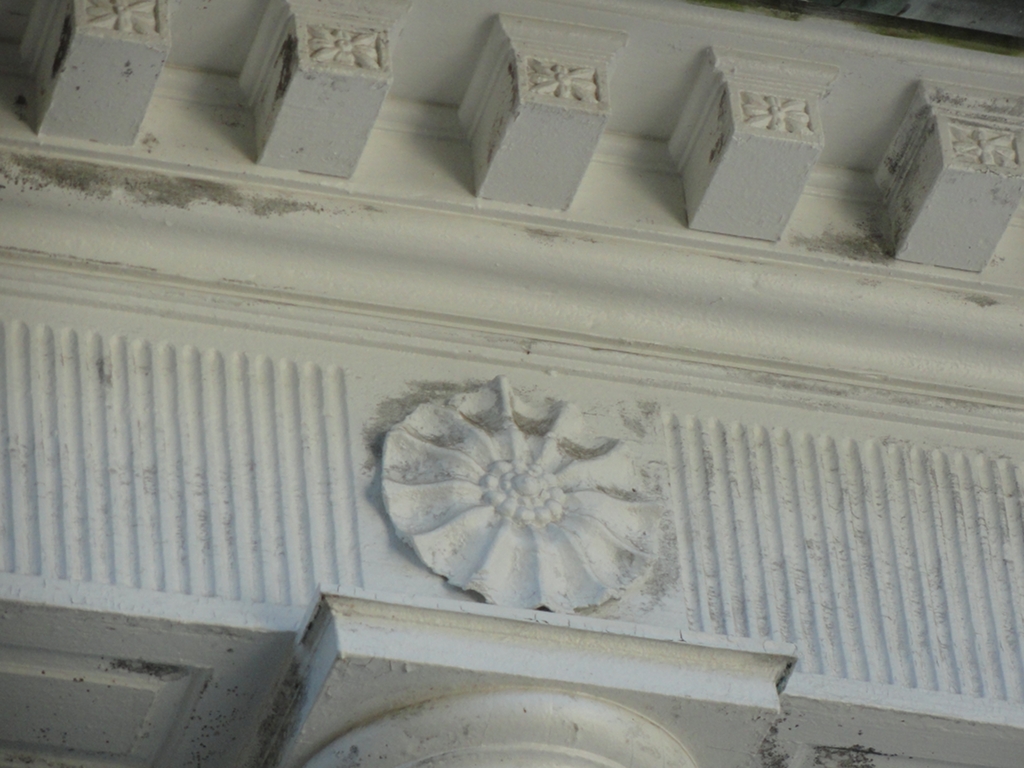
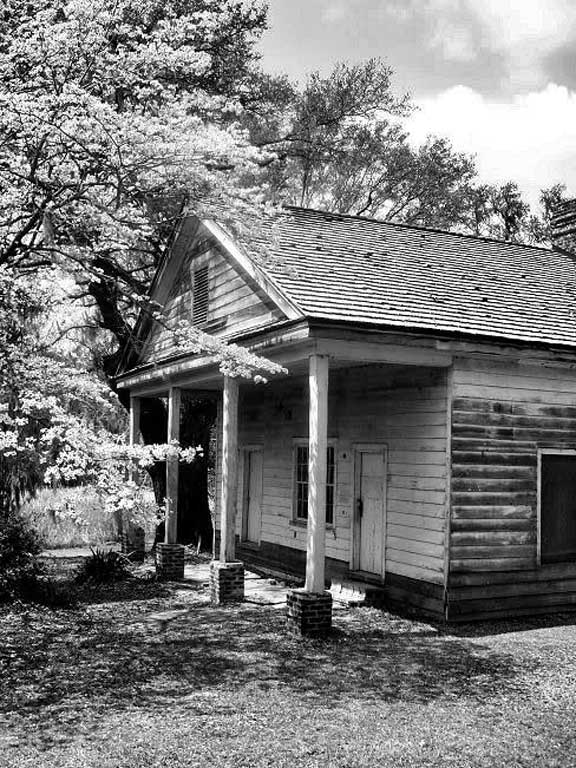
— Detail of Porch at Hampton Plantation © Michael Kaynard, 2012 —
(Do Not Use Without Written Consent)