
Lowndes Grove Plantation – Charleston – Charleston County
Basic Information
- Location – Ashley River, Charleston, Charleston County
Located at 266 Saint Margaret Street on the Charleston peninsula near The Citadel and Hampton Park
- Origin of name – ?
- Other names – Grove, Grove Farm, Wagener Farm
- Current status – Wedding and event venue
Timeline
- 1701 – Earliest known date of existence
Patrick Scott received a grant for 170 acres known as Grove Farm. The acreage was part of the original Dalton grant (4).
- 1738 – The property along with additional land north was conveyed by Daniel Cartwright to John Braithwaite from whom it passed to John Gibbes. Gibbes called the property Orange Grove but it was later to become known simply as the Grove (4).
John Gibbes had a house built on the property but it was burned during the Revolution (2, p. 3).
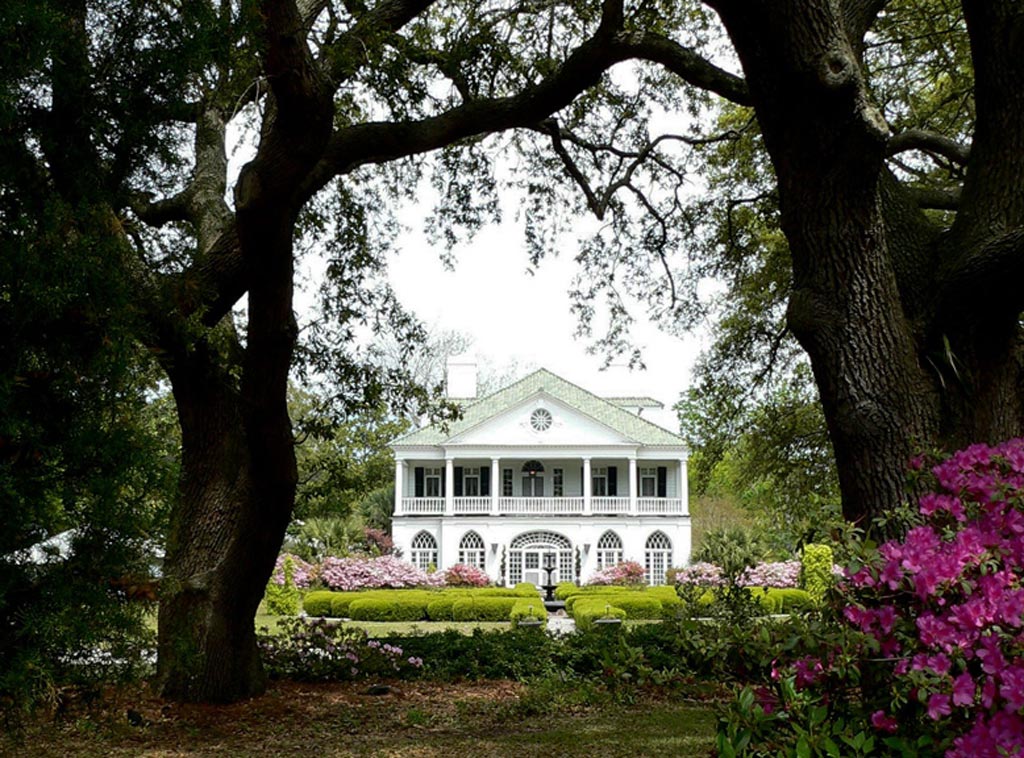
- 1786 – George Abbot Hall purchased the plantation around this time. He proceeded to build a plantation house which still stands today albeit some modifications and additions (2, p. 3).
George Abbot Hall immigrated to South Carolina from England. In 1780 he was exiled to St Augustine, Florida for supporting the Patriots during the American Revolution (5).
- 1791 – George Abbot Hall died August 1. An inventory was done of everything George Abbot Hall owned at the Grove.
It is not known who purchased the plantation upon his death (2, p. 3).
- 1803 – William Lowndes purchased the plantation. From this point on the property was referred to as Lowndes Grove.
William was born on Horseshoe Plantation in Colleton County. He served in the South Carolina House of Representatives and was elected to the United States Congress in 1810 (2, p. 3).
- 1822 – On October 27 William Lowndes died at sea while en route to England. His remains were buried at sea (6).
- 1830 – The portico of the house was probably altered around this time. It went from a double portico to a five-bay piazza with Doric columns. The rear of the house was also enlarged around this time (2, p. 3).
The plantation changed hands several times before being purchased by Frederick W. Wagener (2, p. 3).
Wagener was one of Charleston's wealthy Germans. He started as a grocer and became a leading industrialist, resort owner, and entrepreneur. He was an active member of the Charleston Merchant's Exchange (8, p. 169).
- 1901-1902 – The South Carolina Interstate and West Indies Exposition was held in Charleston. It was the brainchild of Frederick W. Wagener in order to promote trade with the West Indies and Latin America. Lowndes Grove was used as the Women's Building, housing artistic and historical displays (2, p. 3).
- 1917 – Lowndes Grove became the property of James Sottile, Jr. He proceeded to develop the land into streets and lots.
- 1989 – Charles and Martha Craven purchased the plantation on September 20, the day before Hurricane Hugo hit (11).
- 2000 – Alexander and Tina Opoulos III purchased the main house and most of the property from from Charles and Martha Craven (10).
- 2002 – The Opouloses bought the adjoining carriage house and folded both holdings under the umbrella of Lowndes Grove Inc. (10).
- 2007 – Lowndes Grove was sold to Patrick Properties, LLC. They plan to renovate the house and open it as an event venue.
Land
- Number of acres – 232 in 1770; 14 in 2008
- Primary crop – ?
Owners
- Alphabetical list – John Braithwaite; Daniel Cartwright; Charles and Martha Craven; John Gibbes; Joseph L. Goodman; George Abbot Hall; William Lowndes; Lowndes Grove Inc.; Alexander and Tina Opoulos III; Patrick Properties, LLC; Rose; Patrick Scott; James Sottile, Jr.; Frederick W. Wagener
Slaves
- Number of slaves – ?
Buildings
References & Resources
- Lowndes Grove Plantation's official website
- National Register of Historic Places
– Nomination form - PDF - submitted in 1977
– Photographs, architectural overview
- Historical summary - Charleston County Public Library
- Origins of Charleston Street Names - scroll down to Grove Street
- Genealogy of the Hall Family from Bristol
- Biography of William Lowndes
- 30-15 Plantation File, held by the South Carolina Historical Society
- Don Harrison Doyle, New Men, New Cities, New South: Atlanta, Nashville, Charleston, Mobile, 1860-1910 (Fred W. Morrison Series in Southern Studies)
(Chapel Hill, NC: University of North Carolina Press, 1990)
- Samuel Gaillard Stoney, Plantations of the Carolina Low Country
(Mineola, NY: Dover Publications, 1990), pp. 74-75, 202
- Information contributed by Megan Morgan
- Information contributed by Curt Norman who has been a professional photographer at hundreds of weddings and events at Lowndes Grove. He has worked closely with Chuck and Martha Craven as they often spoke of the events surrounding their purchase of the plantation.
Contact Information
- Lowndes Grove Plantation
266 St Margaret Street
Charleston, SC 29403
Website: Click here
Telephone: 843-853-0246