

Rice Hope Plantation – Oatland – Georgetown County
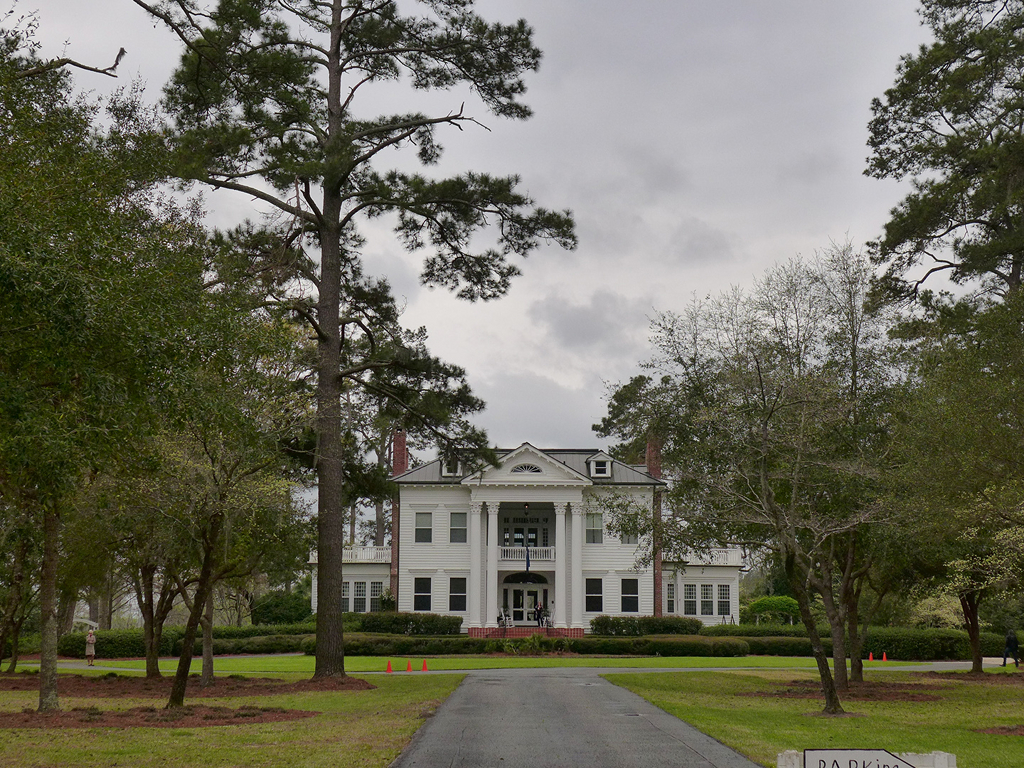
— Rice Hope Plantation © Gazie Nagle, 2015 —
(Do Not Use Without Written Consent)
Basic Information
- Location – Black River, Oatland, Georgetown County
Located northwest of US 701 at Post Foot Landing off Choppee Road
- Origin of name – Named after the rice crop that made so many planters wealthy
- Other names – Black River Plantation, International Paper Company House, Waddell Ranch
- Current status – Privately owned

— Gate at Rice Hope Plantation © Gazie Nagle, 2014 —
(Do Not Use Without Written Consent)
Timeline
- Prior to 1742 – Earliest known date of existence
Daniel Shaw received a warrant for 850 acres (1, p. 8) (2, p. 511).
- 1742 – Daniel Shaw wrote his will stating his son Amos was to obtain a grant for his warrant (2, p. 511).
- 1744 – Daniel died and Amos had the 850 acre warrant surveyed and received the grant (2, p. 511).
- 1751 – Amos Shaw sold the plantation to William Turner (2, p. 511).
- 1754 – William Glenn was owner of Rice Hope (1, p. 7) (2, p. 511).
- 1765 – William and Martha Glenn sold the plantation to Henry Futhy (1, p. 7) (2, p. 511).
- 1797 – Captain Francis Green owned the property (1, p. 7).
- 1807 – William Green was owner (1, p. 7-8).
- 1833 – Sometime after this year, John Potts Ford acquired Rice Hope Plantation (2, p. 513).
- 1856 – Ford died and his wife and daughters remained at Rice Hope. Ford's son-in-law Paul Fitzsimons took over the plantation's rice production (2, p. 513).
- 1871 – Fitzsimons passed away and his wife Martha Selina Ford Fitzsimons appears to have been Rice Hope's owner. She leased the plantation to her son-in-law George LaBruce (2, p. 513).
- 1884 – Martha died and Rice Hope passed to her youngest sister Ann Elizabeth Ford. Ann was married to first cousin Thomas Ford. The Fords ran into financial troubles and obtained a mortgage from Oliver Brightman Skinner using Rice Hope as collateral (2, p. 514).
- ? – The Fords defaulted on the mortgage and Rice Hope was foreclosed on. The plantation would be transferred to Skinner's widow and heirs (2, p. 514).
- 1919 – The heirs of O.B. Skinner sold the plantation to James A. Waddell (2, p. 514).
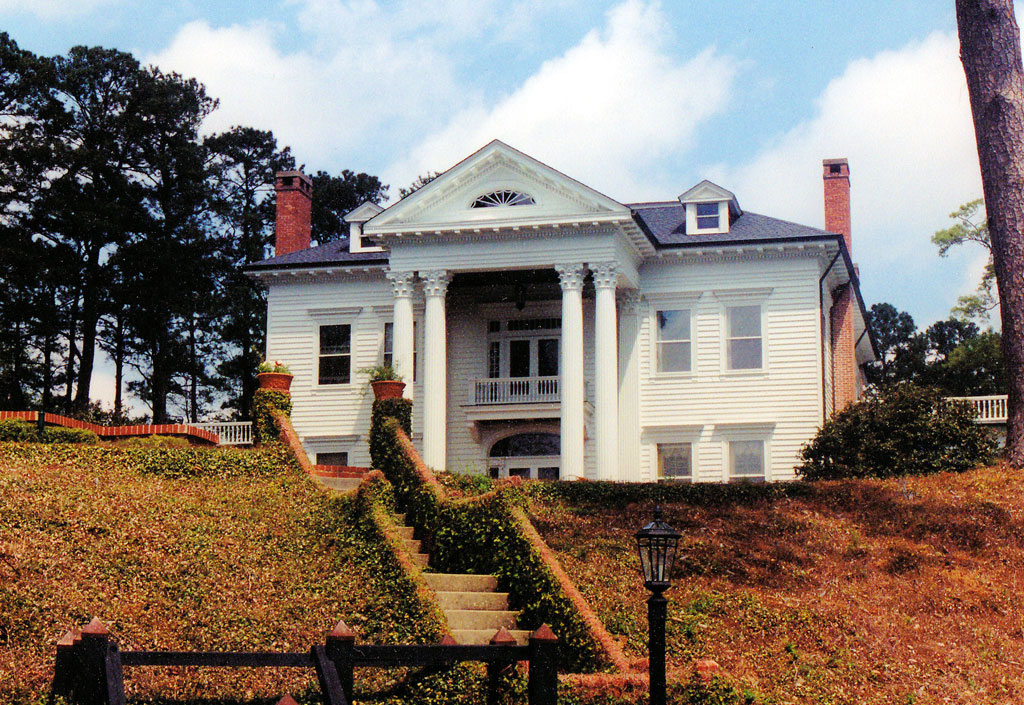
- 1919 – Waddell began a cattle business and deeded the property to the Waddell Ranch Corporation. He also built a large house on a bluff overlooking the river (1, p. 5) (2, p. 514).
- 1928 – Waddell declared bankruptcy and lost the plantation to foreclosure (1, p. 8).
- 1928 – Willis E. Fertig purchased the property (1, p. 8).
- 1942 – The plantation was purchased by the International Paper Company from Fertig and was used as a resort by employees and guests (1, p. 5).
- 1986 – The International Paper Company sold to John and Suzanne Hudson. The Hudsons restored the house and grounds (1, p. 8) (2, p. 514).
- 2004 – The nursing home scenes in the movie The Notebook were shot at the plantation.
Land
- Number of acres – 850 in 1744; 11.25 in 1993 (1)
- Primary crop – Rice
Slaves
- Number of slaves – ?
Buildings
- It has long been rumored that the 1919 house was a Sears 'kit house.' Kit houses were very popular at this time but the Rice Hope Plantation is not a Sears house (1, p. 5).
References & Resources
- National Register of Historic Places
– Nomination form - PDF - submitted in 1993
– Photographs, architectural overview
- Suzanne Cameron Linder and Marta Leslie Thacker, Historical Atlas of the Rice Plantations of Georgetown County and the Santee River
(Columbia, SC: South Carolina Department of Archives and History, 2001)
 Order Historical Atlas of the Rice Plantations of Georgetown County and the Santee River